News & Insights — AI Marketing
What Makes the Best AI Marketing Tool? Context, Not Cleverness
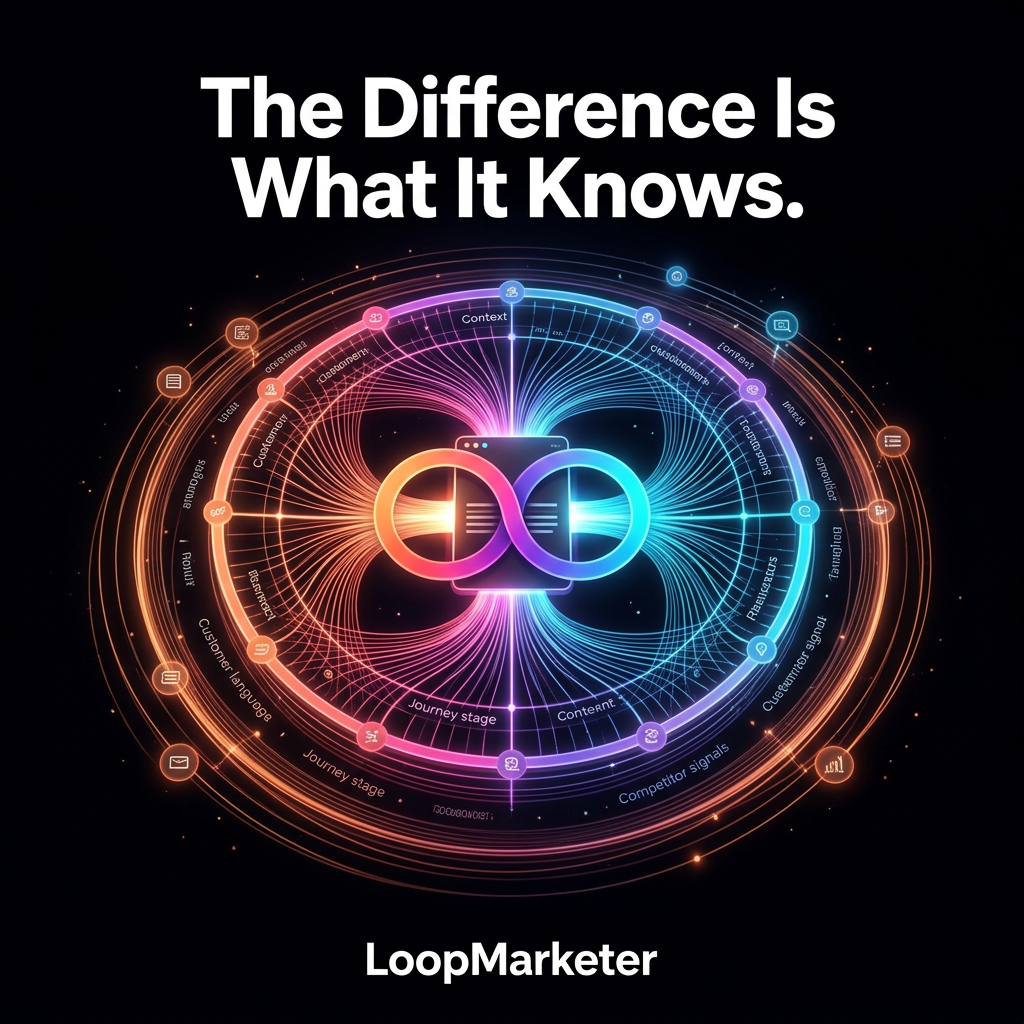
Every AI marketing tool on your shortlist rents a similar model. The difference is context — what the platform knows about your business before it writes.
The best AI marketing tool is the one that knows the most about your business before it writes a single word.
Every serious AI marketing tool on your shortlist is built on similar underlying models, so the model is not the variable. The variable is context: whether the tool holds a documented view of your ideal customer, your positioning, your competitors and your buying journey, and whether it applies that view to every asset it produces.
You have probably already felt the difference without naming it. Tools without that layer generate fluent copy that could belong to any company in your sector. Tools with it produce marketing that sounds like you wrote it on a good day.
Context also decides something newer and more valuable: whether AI assistants cite your business when your buyers ask them for a recommendation. There is ten weeks of data on that further down.
When you compare two or three options, judge them on how much they ask you at setup, not how fast they type.
Context, in this sense, means the documented, reusable knowledge a platform holds about your business: who your customers are, what you claim and refuse to claim, who you compete against, and what a buyer needs to believe before they act. It is written down, applied to every asset automatically, and it improves rather than resets over time.
Who This Is For
This is written for owners and managing directors of small and mid-sized businesses, typically 5 to 80 staff, who have already accepted that AI belongs in their marketing.
You are not a marketer by training. You may have a part-time marketing coordinator, an agency you are quietly unhappy with, or nobody at all.
Budget is real but finite. You are down to two or three platforms and trying to work out which one will still be earning its keep in twelve months, rather than sitting unused in the subscription list.
That worry is well founded. Gartner's 2025 marketing technology survey found that marketers actively use only 49 per cent of their martech stack's capabilities, while martech still consumes roughly 22 per cent of the marketing budget.
The Shortlist All Looks the Same on the Demo Call
The hardest part of an AI marketing tool comparison is that every demo goes brilliantly.
You watch a blog post appear in forty seconds, the interface is clean, the pricing is reasonable, and you leave no clearer than when you arrived. In our own sales conversations, the same sentence comes up more than any other: it all sounds good in the room, but I cannot tell what I am actually buying.
Then the trial starts, the first outputs land, and the reaction is familiar.
Generic. Slightly off. Confident about things your business does not do.
You end up rewriting everything, which was the exact job you were trying to stop doing.
If you have not yet set a baseline to measure any of this against, start with our guide to judging an AI marketing tool's effectiveness before you buy. This post assumes you already know what you currently spend and produce.
Why the Model Is Not the Difference
Here is the part vendors rarely lead with. Most AI marketing platforms do not build their own models, they rent them.
Industry analysis of the category is blunt about it: these products call a third-party API from OpenAI, Anthropic or Google, add an interface, and sell the result, with the value coming from the templates, the workflow and the tuning layered on top rather than the intelligence underneath. Notion AI, for instance, runs on Claude.
That is not a criticism. Renting the engine is sensible. But it does mean that when a salesperson tells you their AI is smarter, they are usually describing someone else's work.
It is the thing that should reshape how you compare your shortlist.
If two platforms are calling comparable models, then the difference in output cannot be cleverness. It can only be what each one was told before it started writing.
Cleverness is commodity. Context is not.
Why the Best AI Marketing Tool Starts With Foundations, Not Prompts
LoopMarketer.AI is built on the belief that output quality is decided before generation, not during it.
What the Foundation stage actually produces
Every account begins with a Foundation stage: four working documents covering your Ideal Customer Profile, your Messaging Framework, your Competitor Landscape and your Customer Journey Map.
These are not onboarding forms that get filed away. They are the reference layer the platform reads every time it drafts a blog, an email, a landing page or a social post.
You could hand them to a new marketing hire on day one and they would be useful. That is the test of whether onboarding produced anything real.
The setup questions that predict output quality
You can tell the two apart before you have spent anything, because the difference shows in what a platform asks you on day one.
- Audience. A context-light tool asks who your target market is. A context-led tool asks who buys, who blocks the purchase, what triggers the search, and what they fear getting wrong.
- Positioning. A context-light tool asks what tone of voice you want. A context-led tool asks what you claim, what you refuse to claim, and why a buyer picks you over the named alternative.
- Competitors. A context-light tool asks nothing. A context-led tool asks who you lose to, on what grounds, and the language they already own.
- Journey. A context-light tool asks nothing. A context-led tool asks what a buyer must believe at each stage before they will act.
- Proof. A context-light tool asks you to upload your logo. A context-led tool asks for your real pricing, your evidence and your regulatory constraints.
If a platform can produce work without asking the right-hand column, it is producing it without knowing you.
Why this beats a better prompt
A junior copywriter given your positioning document, your competitor list and your customer objections will produce better work than a senior one given none of it.
The same logic applies to AI. Cleverness is commodity, context is not, and that is the practical difference between a tool that writes and a marketing team in a box.
The result reflects your actual pricing, your actual objections and the words your customers use, rather than a plausible average of your industry. You can read how the Foundation stage works in detail before you commit to any AI marketing tool.
What Ten Weeks of AI Visibility Data Showed Us
Being found inside AI assistants is now a measurable channel, and it responds to the same context principle.
The result
One anonymised LoopMarketer.AI client, a professional services firm with eleven staff, published to a Foundation-led content programme for ten weeks.
At the start, they appeared in AI assistant answers for zero of the twenty-eight buying questions we tracked. By week ten, they were cited in nineteen of them, including six questions naming a competitor.
That is a single client over a short window rather than a typical outcome, and we quote it for the mechanism rather than the number.
Why it worked, and why it should work for you
Nothing exotic caused it. The content answered specific questions their buyers actually ask, in plain English, with the business named and the service defined.
This is where smaller businesses have an advantage they rarely realise. Analysis of AI citation behaviour finds that a small site covering one narrow subject can outcompete a large general publication for those specific citations, because depth of focus reads as reliability to a model.
The format matters too. A study of 11.1 million citations across 571,729 AI answers found how-to guides and product or feature pages together account for roughly 45 per cent of everything AI engines cite.
And the traffic is worth having. Seer Interactive found visitors arriving from ChatGPT convert at 15.9 per cent against 1.76 per cent for organic search, because the assistant has already qualified them before they click.
Assistants cite sources that are unambiguous about who they serve. Vague content, however polished, gives an assistant nothing to quote.
Put bluntly: a model will not recommend a business it cannot describe.
Key Takeaways
- Competing AI marketing tools rent comparable models, so cleverness is not the differentiator.
- Context is: documented ICP, messaging, competitor and journey knowledge applied to every asset.
- Judge a platform by what it asks you at setup, not how fast it generates.
- Context-led content is what AI assistants can quote, and assistant traffic converts far better than organic search.
Step by Step: How to Test Two or Three AI Marketing Tools Properly
1. Write down five questions your best customers ask before they buy. Use their words, not your marketing language. These become your test set.
2. Ask each platform what it needs from you before it generates anything. If the answer is "just a prompt", you have your result. Serious tools ask about audience, positioning, competitors and objections.
3. Ask what onboarding produces, and request to see it. A configured dashboard is not a context layer. Documented customer, messaging and competitor work is.
4. Give every tool identical inputs during the trial. Same brief, same five questions, same length. Any advantage that comes from one tool getting a better prompt tells you nothing useful.
5. Score the outputs on three things only: factual accuracy about your business, whether it sounds like a person when you read it aloud, and how much editing it needs before publication. Time the editing. That number is your real cost.
6. Check the language dimension. Spelling, currency, regulatory references and tone. A platform your team can use without translating every draft saves hours a month.
7. Ask what happens in month six. Does the tool learn from what you publish, or does it restart from zero every time you log in?
What to Watch Out For
- Credit-based pricing that looks cheap at ten posts a month and becomes expensive the moment marketing actually works. Model your real volume, not the trial volume.
- Tools that treat brand voice as a tone slider. Voice is what you say and refuse to say, not just how formally you phrase it.
- Impressive template libraries hiding thin personalisation. A thousand templates fed no context produce a thousand generic assets.
- Platforms that need a marketer to operate them. If you are the one logging in at 8pm, the interface has to assume you are not a specialist.
- Lock-in on your own strategy documents. Ask whether you can export your positioning and audience work if you leave.
Quick Checklist
- List your two or three shortlisted AI marketing tools and the exact monthly cost at your realistic usage.
- Draft your five customer questions before any trial begins.
- Run the read-aloud test on every sample output. If you would not say it, do not publish it.
- Time how long each output takes to edit to publishable standard.
- Confirm the platform defaults to your spelling, currency and regulatory conventions.
- Check whether the platform holds documented ICP, messaging, competitor and journey context, and ask to see it.
- Search three of your buying questions in an AI assistant and note whether you or a competitor appears.
- Set a review date twelve weeks after purchase with one measurable outcome attached.
Download the AI Marketing Tool Scoring Checklist (PDF) and score each shortlisted platform as you go.
You can also compare what is included at each level before your trials begin.
Frequently Asked Questions
What is the best AI marketing tool for a small business?
The best fit is the tool that captures your business context up front and applies it consistently, rather than the one with the largest feature list. For smaller businesses without a full marketing team, prioritise platforms that handle strategy and production together and require no specialist operator. Test with your own customer questions before comparing prices.
If they all use the same models, does the platform choice matter at all?
It matters more, not less. When the underlying intelligence is comparable, everything that separates two platforms sits in the layer above it: what context they capture, how consistently they apply it, and whether a non-specialist can operate them. That is a far easier thing to test than model quality, because you can see it in the setup process before you have spent anything.
How can I tell if AI content sounds human?
Read it out loud. Content that passes varies sentence length, commits to specifics, and avoids stacked adjectives and hedging phrases like "in an ever-changing landscape". If a paragraph could describe any competitor in your sector without changing a word, it was written without context.
Does AI marketing content help me appear in ChatGPT and other AI assistants?
Yes, when the content answers defined questions clearly and names the business and service explicitly. Assistants surface sources they can quote with confidence, and how-to guides and product pages make up close to half of all citations. Content that is specific about who you serve, where and at what price is far more likely to be cited than general thought leadership. See what you get for how that content is produced.
How long before an AI marketing platform shows results?
Expect early signals within eight to twelve weeks if you publish consistently. In the anonymised case above, visibility in AI assistant answers moved from zero to nineteen tracked questions across ten weeks, though that is one client rather than a benchmark. Traffic and enquiry volume typically lag visibility by a further month or two.
Ask What They Know Before You Ask What They Can Write
You are at the point where more research stops helping. Two or three tools, similar pricing, similar promises, and a decision to make.
The question worth answering is not which platform is cleverest. It is which one will still know your business in six months, when you are busy and marketing is the thing that slips.
So ask each shortlisted supplier to show you what they know about your customers before they show you what they can write. The answers will separate your shortlist faster than any feature comparison.
See your own ICP, messaging and competitor landscape mapped out in a live session, using your business rather than a demo account.