News & Insights — AI Marketing
The Compounding Effect: Why Marketing Gets Easier (and Better) Over Time
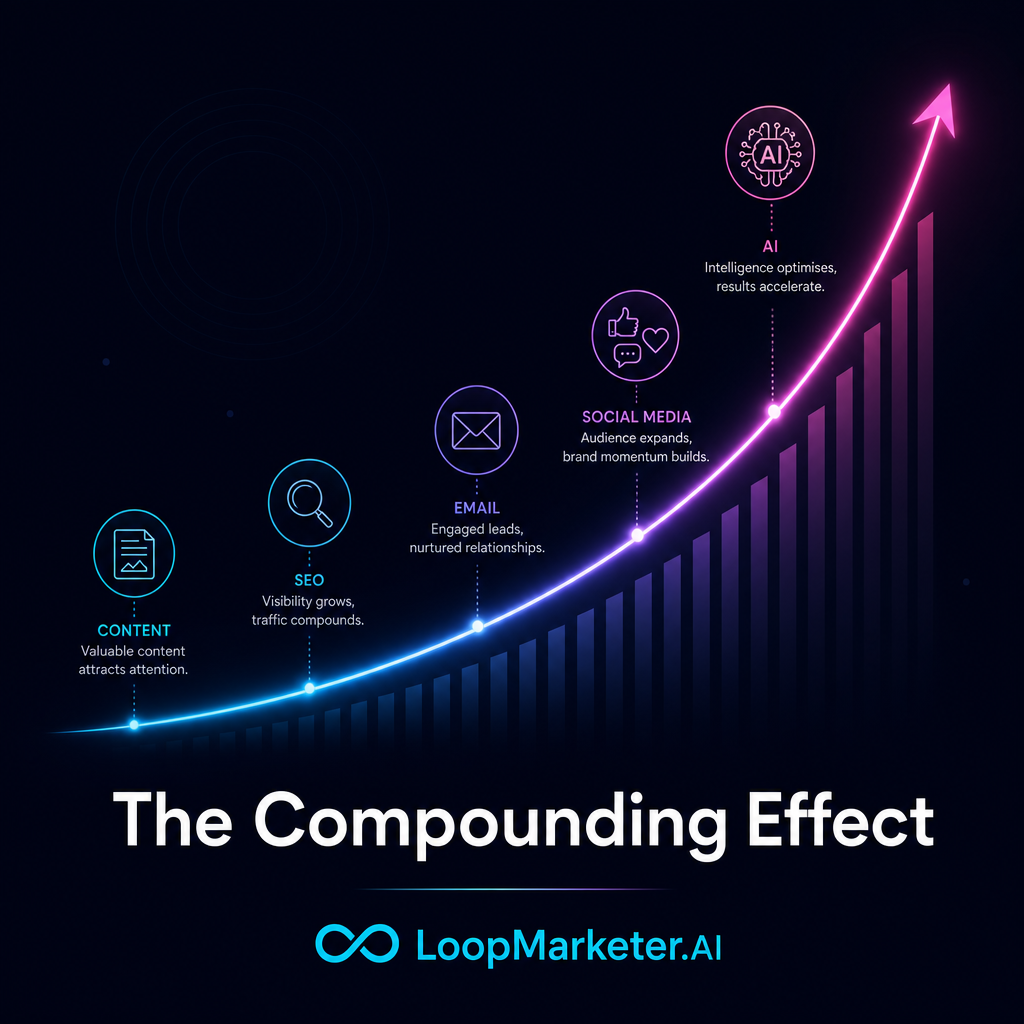
Compounding marketing results UK small businesses achieve come from consistent content, SEO, email, and AI. Discover how marketing ROI improves over time and how to start building momentum today.
If you’re a small business owner, an operations professional who’s somehow ended up running the marketing, or a solopreneur trying to build your brand between client calls, you’ve probably asked yourself: when does this get easier? The honest answer is that it does, but only if you’re building the right foundations. That’s what compounding marketing results UK business owners are starting to discover, and it changes everything about how you should think about your marketing effort today.
What Is the Compounding Effect in Marketing?
Compounding in finance means your returns generate their own returns over time. The same principle applies to marketing. Every blog post you publish, every email campaign you send, every social post that lands well; these don’t just produce a one-time result. They build on each other. Content gets indexed by search engines. Trust accumulates with your audience. Your brand becomes recognisable. Your data gets richer. And slowly, then suddenly, the effort you put in starts producing disproportionate returns.
For UK SMEs operating with limited time and budget, this isn’t just an inspiring concept; it’s a practical strategy. Understanding compounding marketing results gives small business owners a reason to stay consistent even when early results feel underwhelming.
Why the First Few Months Feel Hard (And Why That’s Normal)
Here’s what nobody tells you at the start: the hardest part of marketing isn’t the tactics. It’s the patience. When you’re already wearing six hats and marketing is hat number seven, it’s tempting to either give up early or jump between strategies looking for the quick win.
Sound familiar? If you’re an operations-focused professional who’s been handed the marketing brief, or a solopreneur fitting brand-building around billable work, you’re likely stuck in what we call the flat part of the curve; where input is high but visible output is low. This is where most small businesses quit, right before the momentum kicks in.
The key insight is this: the work you do in month one isn’t just for month one. It’s laying groundwork for months six, twelve, and twenty-four. A long-term marketing strategy for SMEs isn’t about doing more; it’s about doing consistently, and letting time do the heavy lifting.
How Marketing ROI Improves the Longer You Stay in the Game
Let’s talk numbers in a way that actually makes sense for a busy small business owner. Marketing ROI over time doesn’t increase because you get lucky. It increases because of several compounding mechanisms working in parallel:
- Content accumulation: Every piece of content you publish adds to a permanent asset library. A blog post written today can drive organic traffic for years. Unlike paid ads that stop the moment you stop paying, organic content keeps working.
- Audience familiarity: People buy from those they know, like, and trust. Repeated exposure across email, social, and search builds that familiarity without you having to start from scratch each time.
- Data richness: The longer you run campaigns, the more you understand what works for your specific audience. Open rates, click patterns, conversion paths — this intelligence makes every future campaign more effective and less wasteful.
- SEO authority: Search engines reward consistency and longevity. A site that’s been publishing relevant content for two years will almost always outrank a site that’s been active for two months, even with similar content quality.
- Referral and word-of-mouth loops: As your brand becomes more visible, more people share it. This organic amplification costs you nothing extra but multiplies your reach progressively.
For UK businesses investing in a long-term marketing strategy, these mechanisms mean your cost per acquisition drops over time, even as your results improve. That’s the compounding effect in action.
Real-World Example: An IT Services Business
Consider the results generated for a UK-based IT services and managed solutions business over a seven-week period, running from May through to mid-June 2026. At the start of the campaign, their digital footprint was thin: minimal organic search presence, almost no social media activity, and a website that received just a handful of sessions each month.
A consistent programme of content publishing, social posting, and on-page optimisation was introduced. Seven weeks later, the numbers told a clear compounding story:
- Website sessions grew by 64.9% year-on-year, with 2,380 sessions in the reporting period versus 1,443 in the same period the prior year.
- Organic search sessions increased by 49.7%, rising from 314 to 470, with service pages now ranking where previously they had near-zero organic visibility.
- The services landing page went from 3 sessions to 348 — an 11,500% increase — as newly optimised service pages began to index and attract visitors.
- Thought leadership content began driving traffic independently, with pages on compliance and licensing topics each generating consistent sessions with zero paid promotion.
- Social media impressions increased by 186.6%, from 1,682 to 4,821, with total engagements up 135.6% (from 149 to 351) — driven almost entirely by a consistent LinkedIn publishing cadence. Organic social sessions from the website also grew by 323% over the same period.
None of this was the result of paid advertising. It was the result of consistent content, applied systematically, allowed to compound. The most telling signal: the fastest-growing sessions were on service-specific and insight pages — exactly the kind of high-intent entry points that convert visitors into enquiries.
Seven weeks. No ad spend. Just consistent, intelligent content — compounding in real time.
Where AI Fits Into This Compounding Equation
This is where it gets genuinely exciting for time-pressed professionals. AI marketing improvement isn’t just about doing things faster — it’s about accelerating the compounding curve itself.
Traditional marketing required you to manually analyse what was working, adjust campaigns, rewrite content, and test variations. That takes time — time you don’t have when you’re also running operations, serving clients, or managing a team. AI changes the equation by doing the learning and optimising for you, continuously, in the background.
What AI Does to Speed Up Compounding
- Learns your audience faster: AI tools analyse engagement data and identify patterns far quicker than manual review, meaning your campaigns become smarter after just a few cycles rather than dozens.
- Personalises at scale: Where previously you’d send one message to everyone, AI enables tailored messaging based on behaviour, interest, and stage in the buying journey — dramatically improving conversion rates without extra effort from you.
- Reduces wasted spend: By identifying underperforming content and channels early, AI helps you reinvest budget into what actually moves the needle.
- Creates consistency: One of the biggest compounding killers for small businesses is inconsistency. AI-assisted tools help you maintain a regular presence even during your busiest weeks — exactly as the IT services example above demonstrates in practice.
For the overwhelmed small business owner, the reluctant marketer, or the solopreneur managing everything solo, AI doesn’t replace your strategy — it amplifies it. The compounding effect becomes steeper, faster, with less manual effort at every stage.
A Practical Mindset Shift for SME Owners
If you’re currently thinking about marketing as a series of one-off tasks — send a newsletter, post on LinkedIn, run an ad — it’s time for a reframe. Every action you take is either building toward compounding results or resetting the clock.
The most successful UK SMEs are those that treat marketing as infrastructure, not interruption. Just as you wouldn’t stop paying your rent because the office didn’t generate a sale this week, you shouldn’t stop your marketing because a single campaign didn’t immediately convert.
Ask yourself: are you building assets, or just burning budget? Assets appreciate. Spend disappears. Content, email lists, SEO authority, brand recognition — these are appreciating assets when maintained consistently over time.
Getting Started: The Compounding Marketing Framework for Busy Professionals
You don’t need a massive budget or a dedicated marketing team to start building compounding results. You need a repeatable system. Here’s what that looks like in practice:
- Choose two or three channels and commit to them consistently rather than dabbling in everything at once. The IT services business referenced earlier focused on LinkedIn and organic search — and both compounded meaningfully within weeks.
- Create content with a long shelf life — educational blog posts, how-to guides, and FAQs that answer the questions your ideal clients are already searching for.
- Build your email list from day one — this is an owned asset that compounds independently of algorithm changes or platform shifts.
- Track what matters — not vanity metrics, but leading indicators like email open rates, website session duration, and inbound enquiry sources.
- Use AI-assisted tools to automate repetitive tasks and accelerate your learning curve so you can stay consistent without burning out.
Compounding marketing results for UK businesses don’t require perfection. They require persistence and a system that works even when you’re busy — which, let’s be honest, is always.
The Bottom Line: Time Is Your Most Powerful Marketing Asset
Whether you’re a solopreneur fitting brand-building around client work, an operations manager who inherited the marketing brief, or a small business owner doing everything yourself — the single greatest thing you can do for your marketing is start building now and keep going.
The businesses that seem to have effortless marketing didn’t get lucky. They started earlier, stayed consistent, and let time and data do the compounding work. The IT services business referenced in this post had virtually no organic visibility twelve months ago. Today, it’s generating hundreds of sessions each month from content alone — sessions that cost nothing to maintain and will keep arriving long after the content was written. With the right tools and strategy, you can accelerate that timeline significantly and spend far less energy fighting for attention once the momentum builds.
Marketing ROI over time isn’t a theory. It’s maths. And the sooner you start, the better the numbers get.
Ready to See What Compounding Marketing Looks Like in Practice?
If you’re tired of starting and stopping, guessing what works, and spending hours on marketing that doesn’t seem to go anywhere — it’s time to see a smarter approach. Our AI-powered platform is built for exactly the kind of busy professional who needs results without the overwhelm. See how it works for your business and discover how quickly you can start building the kind of compounding marketing results UK business owners are already achieving.